Kartik Nair | 18th November 2025
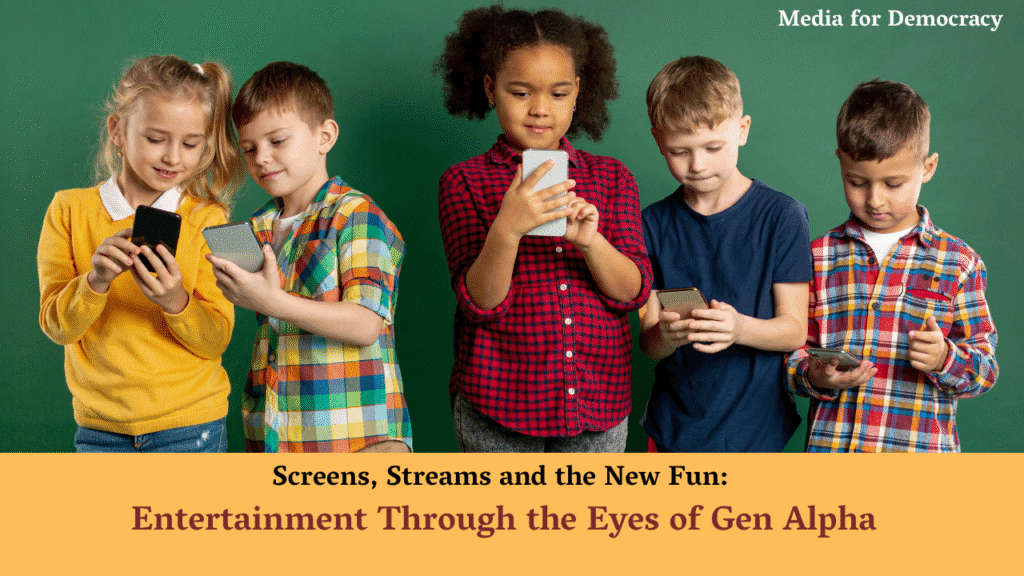
Entertainment in this city has changed faster than the Mumbai local train rush hour. Earlier, families sat together on the table, then they started sitting in front of the TV. Weekly movies on Doordarshan were a big event. Today the young audience and the even younger audience the Gen Alpha carry their own entertainment that is suitable for the in their pockets. A world full of apps, games and reels. Playlist that is liked and shared by them. They are not just watching entertainment, they are shaping it.
Mumbai, the heart of Bollywood , is now also the hub of YouTube creators, gamers, and social media influencers. This new generation has shifted the spotlight. For them the screen in the palm is more powerful than the big cinema screen.

“I want to become a YouTuber!” The new dream
A ten year old in my building plays Minecraft on his tablet every hour of everyday. When asked why does he play for such a long time, he says, “ I wish to be a pro in this game and when I grow up i will be a gaming youtuber, people will watch me and play and ill get lots of likes and subscribers also”. He says with enthusiasm and excitement in his voice as if he is already famous.
This is not a one off dream. There are many such children barely 13 year old who have a driving force behind them to become famous, to be heard, seen, liked by millions. They wish to have fans more then actors nowadays.
In my own family, my younger cousin who is 10 plays Roblox in his IPad all day long. He has been bought a cycle to ride, but that cycle has not seen the light of day. Glued to the screen like he has been hypnotised. “I am an expert in this game and no one can beat me” he says. “I also like watching YouTubers and copy their gaming style so I can improve my own” he added.
Entertainment has become a stage where even children want their spotlight.
Short fast and always scrolling
The attention span of the young has become short like the city’s cutting Chai , quick but strong. Reels and short videos win over long movies and tv shows. Gen Alpha dive from one video to the next in seconds. They like fun that arrive quickly and never stops.
Inside local trains, metros, auto rickshaws they have a screen on them. During the 10 minute break in tuition they check for WhatsApp messages. The screens are everywhere, the habit of scrolling has become a part of their daily life.
A teacher from secondary section shares, “Sometimes students do not remember what I taught yesterday, but they have exact knowledge of almost every meme and trend that is viral now.
Entertainment is no longer break from the daily life, it is a daily life.

Gaming: A new playground
Instead of cricket in the street, many children now meet their friends in online battlefields. Games like BGMI, Free Fire, and COD Mobile are the new playgrounds. Children when asked say that, “Gaming helps us make new friends. We have our own WhatsApp group for games where we decide what time we can meet up online. We play, we talk, we laugh together, it indeed feels like a team.”
Games today are not just about the gameplay. They are social spaces where it gives confidence among them. A sense of achievement. But such things have a flipside. It can lead to long hours of indoor games with less physical activity. This may lead them to make purchase and spend money unnecessary.
Cinema vs. OTT. Who is winning?
The cinema in the city is still alive, but the magic is fading very fast for everyday entertainment. The kids these days watch the content on the OTT. The most of them wait for the content to come on OTT platform like Netflix and JioHotstar.
“Abhi itna mehenga ticket leke picture dekhne kon jaayega. Popcorn khareedne ke liye kidney bechna padega. ( Now who is going to buy such expensive tickets and go watch a movie. To buy a popcorn we may need to sell our kidney) Is what the youngsters are saying.”

Apart from this Bollywood is not the only love the Alpha Gen have. K-Pop is something they like nowadays. The reason being that the really good character arcs that the writers give the story.
Japanese anime are also some to the new genre that is taking the hearts by storm. Such is the glory of the genre.
The bright and the dark sides
While digital entertainment gives confidence, creativity, and fun, it also has a completely different silent danger side. Screen addiction. Online bullying. Endless comparison between players. Loss of real human connection.
A parent says, “My 7-year-old cries if we take away the iPad. Entertainment is now harmful. I fear for my sons eyesight and his studies.” Gen Alpha children get mobile phones earlier than they learn to ride a bicycle. It is a big shift that needs balance and guidance. When we were kids, we used to beg our parents to buy us a cycle. And in the end it used to depend on our exam results.
The Gen Alpha have it a bit easy these time
Family divide
Entertainment often creates arguments at home
Parents ask: “Why so much screen time?”, “Why do you follow these influencers?”, “Why do you not go outside and play?”
Kids reply: “Everyone does it.” , “This is how we have fun.” , “This is normal.”
This clearly shows a communication gap between parents and their ward. Instead of blaming their children, the parents must try to understand their world.
What can we do?
Listen to the youth, teach media literacy, encourage creative use of technology, protect mental health, support local culture, build family time.
Gen Z and Gen Alpha in Mumbai are smart, expressive, and full of ideas. They live in a world full of choices that older generations never had. Instead of saying “this is bad,” we must listen and guide.
If we give the right support, today’s young screen-lovers can become tomorrow’s storytellers, innovators, and leaders. Entertainment is changing, but change can be beautiful if we shape it with care, balance, and love.
Kartik Nair is a media researcher who studies cinema, culture, and social change. His work explores how films and popular narratives shape public understanding of issues like caste, inequality, and representation in contemporary India.