Prajakta Kadam & Chatura Juwatkar
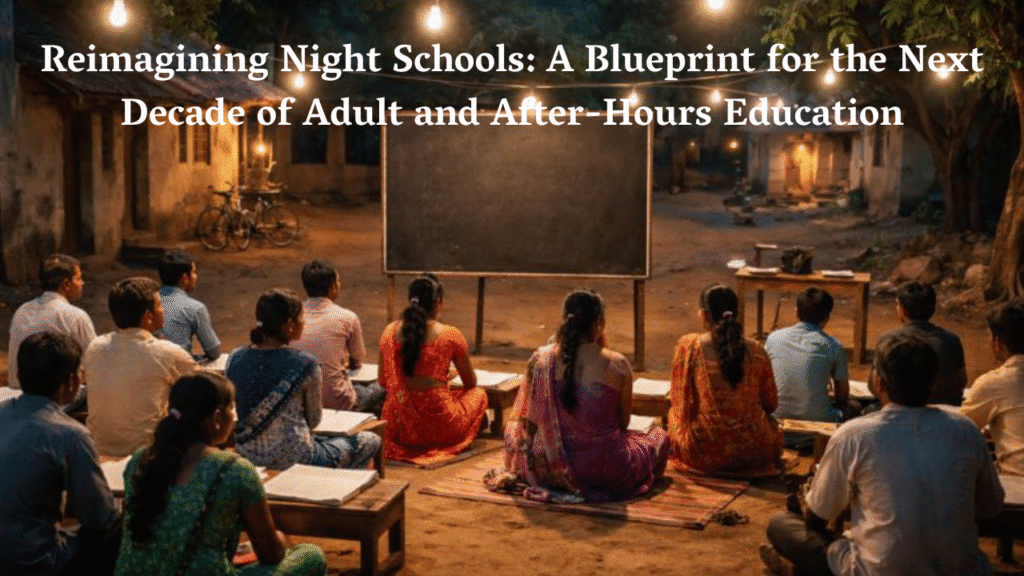
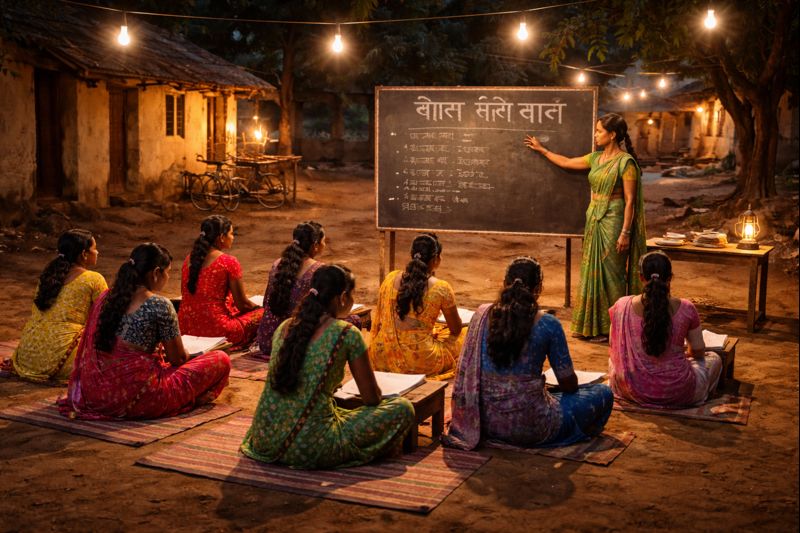
Night schools in India have always been about second chances. But over the last couple of years of sitting in cramped classrooms after 6 PM, watching women in uniforms from retail shifts, security guards in dusty shoes, and gig workers still carrying their delivery bags, a pattern has emerged: these spaces are already doing far more than “remedial education.” They are quietly functioning as skill centres, support groups, job bridges, and safe public spaces rolled into one. The next decade is not about defending the existence of night schools but about reimagining them as modern community learning hubs wired into the economy, technology, and the state’s vision of lifelong learning.
From classroom to community learning hub
Most night schools today still resemble day schools with different timings: blackboard, benches, a single teacher trying to “finish the syllabus.” The lives that walk in after dark into these rooms are far more complex than any textbook. Reimagining these institutions starts with accepting that an adult learner is not a child at a different hour, but a worker, caregiver, migrant, or parent carrying fatigue, responsibility, and urgency.
A forward-looking blueprint would convert night schools into community learning hubs with four core functions. First, academic completion: helping adults finish Class 10 and 12 equivalents, prepare for open schooling exams or bridge courses. Second, livelihood learning, short job-linked courses in retail, data entry, hospitality, digital marketing, basic coding, and local trades. Third, life skills and rights: financial literacy, digital banking, health information, social entitlements. Fourth, community support, a place where people can access information, counselling, and peer networks. The blackboard remains-but beside it are notice boards with job postings, QR codes linking to government schemes, and schedules for weekend workshops.
Hybrid evenings, offline trust, online scale
One clear takeaway from field visits is that adult learners trust physical spaces and known teachers. What they lack is continuity: missed classes due to shifts, illness, festivals, or care work quickly become dropouts. The answer is not to replace night schools with apps, but to weave in a hybrid learning layer that respects their realities.
A practical model could be: three evenings a week in-class, anchored by a local teacher, plus light online or phone-based modules on weekends. Content can be delivered through low-data videos, WhatsApp micro-lessons, or preloaded devices in centres where connectivity is poor. Class time then moves away from pure lecturing to doubt-clearing, practice, group work, and mentoring. Attendance stops being a rigid gatekeeper; instead, learners follow flexible “learning paths” where progress is tracked by completed modules, not just physical presence. This hybrid structure allows working adults to speed up or slow down without falling off the map.
Partnerships that keep night schools relevant
What frustrates learners at most night schools in this study is simple: “Will this get me a better job?” To answer that honestly, these institutions need to be plugged into wider ecosystems, not left to operate in isolation.
Corporates can co-design short, job-linked modules, customer service for retail, basic CRM skills for call centres, digital tools for logistics, safety and hygiene for hospitality. NGOs bring in expertise related to gender, rights, and community mobilization, while ed-tech companies bring in adaptive learning tools, vernacular content, and analytics that help teachers see who is struggling. The partnership model should be pragmatic rather than ornamental: every external partner must answer at least one concrete question for learners “What skill, opportunity, or certification are you adding here?” Over time, each night school can build a small but living network of local employers and recruiters who know the value of its certificates.
Credentials that count in the labour market
Adult learners are not chasing marks for their own sake, they are chasing recognition. At present, many of them straddle a confusing world of informal certificates, NGO badges, and unrecognised training. The next decade should be about cleaning up this landscape.
A reimagined system would ensure that every serious course-academic or vocational-links to a recognised board, an open schooling system or a sector skill council. Even micro-courses-let’s say a 30-hour module in digital marketing basics-can stack into a larger, recognised qualification. Digital certificates, verifiable through QR codes, can sit in a simple learner “wallet” accessible on a basic smartphone. For employers, this creates a common language of skills; for learners, it means that every hour spent in a night school leaves a trace that counts.
Flexible exams for inflexible lives
One of the most jarring experiences in field observation is to see a learner on great momentum disappear in the week before exams because of a sudden night shift, a family crisis, or seasonal work. The system treats this as lack of seriousness in reality, it is a design failure.
Assessment in adult and out-of-school-hours education in the coming decade should be moving towards flexible modular assessment. Instead of a single high-stakes assessment at the end of the year, knowledge and skills can be tested in small chunks along the way-unit tests, practical demonstrations, project work linked to real life, such as preparing a household budget or designing a simple marketing flyer for a local shop. Assessment windows can be more frequent and spread out, enabling adults to sit when their schedule allows. Technology can support oral and practical assessment for those individuals with weaker writing skills, such that exams become a reflection of capability, not punishment for irregular attendance.
Centring women, safety, care, and opportunity
Sit in any urban night school long enough, and a pattern begins to emerge: women often arrive a little late, breathless from finishing cooking and child care, or leave a little early to catch the last bus. Some bring along toddlers who fall asleep on their laps. Any blueprint that ignores this reality will fail half of its learners.
Women-friendly night schools of the future would build in three things: childcare corners, safe transport, and batch planning. Even a modest, supervised play area with mats, toys, and basic safety allows mothers to learn with fewer interruptions. Pooled drop services on key routes, partnerships with local cab operators, or route-based volunteer escorts make the difference between attending and staying home. Third, batch planning that recognises women’s domestic peak hours, staggered timings, shorter but more focused sessions, and women-only batches where culturally necessary. Alongside this, targeted modules in financial literacy, digital banking, and entrepreneurship equip women not just to earn, but to control and grow their earnings.
Economics which adults feel immediately
Adult learners have no patience for abstract benefits, and rightly so. To be relevant, night schools need to prove their economic utility fast and visibly. That means integrating everyday financial and entrepreneurial skills into nearly every course rather than treating them as add-ons. A math class using loan interest, EMI calculations, or savings goals as examples; a language class practicing filling forms, writing professional messages, and responding to job ads; a digital class teaching UPI, online safety, bill payments, and basic spreadsheets. For many learners observed in the field, the first burst of pride comes not from passing an exam but from independently handling a bank transaction, negotiating a wage, or pricing their small business product more confidently. Designing for these “small wins” can keep hope and attendance alive during long academic journeys.
Lifelong learning, mental health, and dignity India’s National Education Policy speaks the language of lifelong learning; night schools can be its most grounded expression. For a delivery worker who picks up a new coding skill or a caregiver who completes Class 10 at 35, “lifelong learning” is not a slogan but a lived experience. To honor that, the system must do more than merely transmit information-it must support the whole person. Adult learners often bring anxiety, shame about past academic failure, and the stress of precarious work with them. The addition of some basic mental health support-peer support circles, occasional group counseling sessions, referrals to local services-can be transformative in terms of retention and outcomes. Simple rituals matter: celebrate small milestones, publicly acknowledge effort, and treat late starters not as “dropouts who returned” but as serious students. In the next ten years, the most successful night schools will be those providing not just content and certificates but community, confidence, and a renewed sense of worth. Reimagined thus, night schools cease to be the afterthought of the education system but become its most honest frontier. They are where policy slogans about equity, skill, and lifelong learning collide with the real, messy schedules of working adults. The work ahead is to equip such spaces with the tools, partnerships, and flexibility they need-so that when the city winds down after dark, its classrooms can light up futures with far more than chalk and rote.
Chatura Juwatkar and Prajakta Kadam are media educators who believe in amplifying stories of resilience, learning, and unsung changemakers through their work.