Sinjini Ghose | 18th November 2025
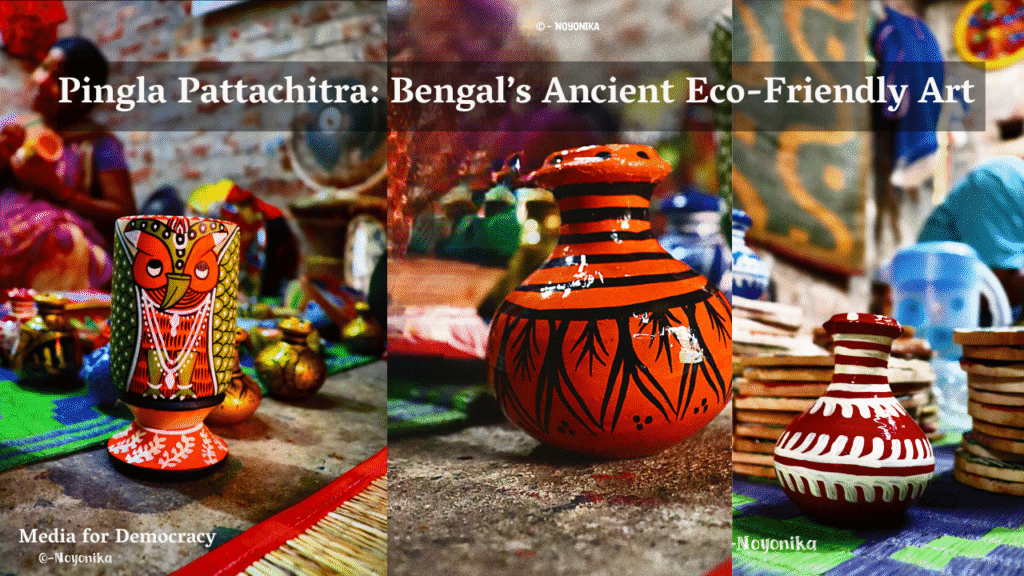
West Bengal’s Pingla village is well-known for its rich culture and Patachitra tradition, an age-old style of scroll painting. There is a thriving Patua (the painters) community in Pingla. paintings by Patwas, who illustrate mythological stories, folklore, and social issues using natural colors and storytelling combined with music and song.
Some Pingla patas are hand-painted in continuous narrative frames that are 10 to 20 feet long, much like comics, but they were created more than 200 years before the advent of comics.
UNESCO Recognition Path:
Pingla patachitra has been considered under multiple cultural heritage documentation programs and has been exhibited internationally. Festivals like “Potmaya” held annually in Pingla attract a global audience and researchers.

Fusion of Religion & Secularism:
Patuas narrate stories from Hindu mythology (Ramayana, Kali, Durga, Manasa Mangal) AND Islamic traditions because historically Patua communities had mixed religious identities. Many have Muslim surnames yet worship Hindu deities. This syncretic culture is very unique to Pingla.
Oldest Eco-Friendly Natural Painting Tradition of Bengal:
Without industrial interference, it is still practiced in rural Bengal today, making it one of the oldest surviving eco-friendly art systems in the world. By doing this, Pingla not only conserves cultural heritage but also serves as a potent illustration of sustainable creativity long before the term “eco-friendly” gained international recognition. In contrast to contemporary paints that use chemicals and industrial pigments, the Patuas make their own dyes with materials that they can find locally, such as soil, fruits, flowers, leaves, ash, stones, and forests.

They use colors from nature, such as:
- Turmeric gives yellow color,
- Red laterite soil (gerua mati) gives red color,
- Indigo plants produce deep blue color,
- Burnt rice husk or charcoal gives black color,
- Flower petals like Aparajita / Krishna Chura / Hibiscus create various tones of pink, purple, and red,
- Rice paste & tamarind seeds are used as natural binders.
Even the brush is handmade. Bamboo sticks form the brush handle, and fine hair from domestic animals or soft cotton threads are tied to form the brush tip. From the painting surface, to brushes, to colours — the entire process is zero-waste, biodegradable, non-toxic, and climate-friendly.
The Ancient Root of the name Pingla:
“Pingla” comes from the Sanskrit / old Indo-Aryan root “Pingala”, which means tawny / yellowish-brown / reddish-golden in colour. It is often used to describe a warm, earthy tone — the same colour range you see in laterite soil (gerua mati), which is extremely common in that region of Bengal. The word is directly connected to colour and earth pigment, which is actually very poetic and symbolically aligned with the natural, colour-based heritage of Pingla Patuas.
“Poter Gaan” – Songs sung by the painters –
In Pingla, the “song” is not just a song – it is actually called Poter Gaan. Every scroll (Pata) has its own narrative song that the Patua sings while slowly unrolling the painted scroll.
This is what makes Pingla unique in the world – the story is not read… it is performed.
This is a traditional form of storytelling through song, which is integral to the Patua art form. As the artist unfurls a scroll, they sing the accompanying narrative in Bengali, modulating their voice to bring the story to life.
Naya Village:
This specific village within Pingla is the center for the Patachitra artists, also known as Patuas. To witness the art form, visit Naya village in Pingla, West Midnapore. The Patuas create painted scrolls called Patachitras and then sing “Pater Gaan” to narrate the stories depicted on the scrolls, which often include folklore, mythology, and social commentary.
Pingla has developed into a hub for rural tourism, with the annual Pot Maya festival being a major attraction that showcases the art and the Pater Gaan performances.

Traditionally, these songs tell:
- Mythological stories (Ramayan, Mahabharat, Chandi Mangal, Manasa Mangal, etc.)
- Local legends/folk tales
- Religious stories
- Social awareness topics (modern pattachitra also includes climate change, women’s rights, cyclone, and environmental issues)
It is one of the oldest forms of audio-visual storytelling in Indian folk culture, where painting + song together become a narrative medium.
In addition to being a place for art, Pingla is a place where stories are passed down through memory rather than textbooks, where music brings paintings to life, and where color blossoms from the soil. Time moves in circles, just like the scrolls themselves, in this one village rather than forward or backward. Art, as demonstrated by the Patuas, is not a luxury but rather a means of identity, protest, heritage, hope, and survival. At a time when everything is moving at the speed of the internet, Pingla is serene, slow, and deeply ingrained. It serves as a reminder that cultural wisdom is created by hand, not by an algorithm. The rhythm of the ancient Bengali earth will continue to reverberate throughout generations and geographical boundaries as long as Poter Gaan is sung.
Sinjini Ghose is an emerging cultural writer who explores India’s rich folk traditions, art practices, and storytelling heritage. Her work blends research with evocative narrative, bringing forgotten histories to life.