Ankita Gupta | 13th November 2025
When one thinks of Mumbai, the bustling city often evokes images of towering skyscrapers, film stars, and glittering skylines. But hidden behind this urban façade lies another reality Dharavi. Known as one of Asia’s largest slums, Dharavi is not just a settlement but a world of its own, where survival demands resilience, creativity, and unimaginable compromises.
During my visit, I witnessed firsthand the fragile lives woven around open drains, narrow lanes, and overcrowded homes. What struck me most was not just the poverty, but the extraordinary spirit of people who continue to survive and work hard despite conditions most would find unbearable.
Living by the Drain
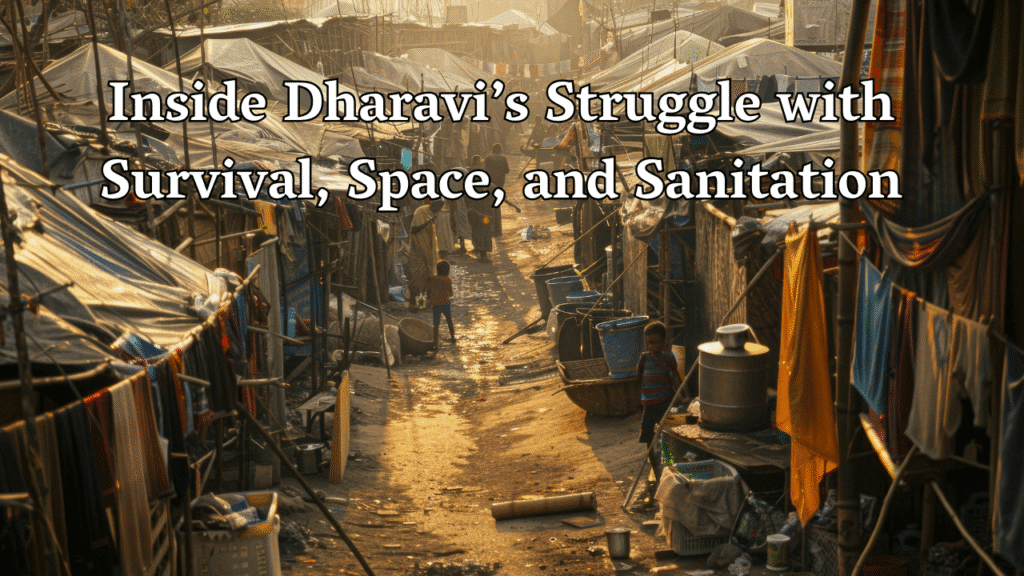
Walking through Dharavi’s jhoper Patti area, the first thing I noticed was the smell a sharp stench rising from open drains. Families live just inches away from these gutters, which overflow during rains and leak constantly into the narrow pathways. For many, the drain is not just a nuisance but also, tragically, a workplace.

In one shocking scene, I saw a man waist-deep inside a gutter, carefully pulling out plastic waste. These scraps, once cleaned and sorted, can fetch a small price from recycling factories. It was heartbreaking to watch him work in such hazardous conditions, but this is survival. “People will do anything to feed their families,” he told me. And indeed, they do.
Children, too, are not spared from this environment. The drains often overflow into lanes where kids play barefoot, splashing in puddles that carry diseases. The lack of proper sanitation is not only a hygiene issue but a health crisis waiting to happen.
Tiny Homes, Shared Streets

“Narrow lanes, endless lives where space is scarce but struggles are plenty.”
Housing in Dharavi is another story of compromise. Families are crammed into tiny single-room homes, often no bigger than a few square feet. Privacy is a luxury that does not exist here. In jhoper Patti, many families cook outside their homes, setting up small stoves in the lanes because there simply isn’t enough space indoors.
The narrow alleys are filled with smoke from outdoor cooking, children running, and women balancing pots of water fetched from community taps. Yet, despite this chaos, there is a sense of order a silent understanding among neighbors to share space and survive together.
The Women of Dharavi
Among the stories I heard, one voice stayed with me Nirmala Devi, a 55-year-old woman who has lived in Dharavi most of her life. Sitting outside her small home, she told me about the daily struggles of women here.
“Women here don’t just take care of the house,” she explained. “We also work outside. Some go to recycling factories, some do pottery, some stitch clothes. But no matter how much we work, the money is never enough.”
The most painful detail she shared was about toilets. Public toilets are few, and the lines are long. Sometimes, women have to wait hours just to use one. For many, especially during menstruation, the lack of hygiene adds another layer of suffering.
Nirmala’s story reflects the double burden women carry in Dharavi managing households in cramped, unhygienic spaces, while also contributing to the family income through long hours of poorly paid labor.

Children Who Grow Up Too Fast
In Dharavi, childhood is often cut short. Many children drop out of school, not out of choice, but because of money. They are drawn into work sorting plastic, assisting in small workshops, or simply helping their families manage daily survival.
During my visit, I saw children playing just a few steps away from the open drain, their laughter mixing with the foul smell. Innocent faces, yet already familiar with hardship. Education, for many of them, is a dream their parents cannot afford.
Factories Amid Filth
Despite its conditions, Dharavi is also known as Mumbai’s recycling hub. Nearly 80% of Mumbai’s plastic waste is processed here. Small factories line the lanes, where workers ,men and women alike clean, melt, and reshape discarded items into reusable goods.
Pottery, leatherwork, and stitching are also common. Walking through these units, I saw workers bent over machines, their hands stained and their backs weary. The irony is striking: Dharavi sustains much of Mumbai’s recycling industry, yet its own residents live in an environment drowning in waste.
Strength Amid Struggle
What moved me most about Dharavi was not just the poverty but the dignity and resilience of its people. The man in the gutter, Nirmala Devi, the children running barefoot all of them showed an incredible will to survive against all odds.
There is pride in their work, even when the wages are low. There is solidarity in their neighborhoods, even when space is scarce. And above all, there is hope that one day conditions will improve, that their children may get a better life.

A City Within a City
Dharavi is often dismissed as a slum, but in reality, it is a city within a city. With its own economy, culture, and community networks, it thrives despite neglect. Yet the questions remain how long will people have to live by open drains? How long will women wait in line for a toilet? How long will children play in unhygienic lanes instead of classrooms?
The answers depend on how seriously urban planners, policymakers, and citizens acknowledge Dharavi not just as a symbol of poverty but as a place of human strength and suffering.
My visit to Dharavi left me shaken. The drainage system, the lack of hygiene, the overcrowding all paint a grim picture. But beyond the statistics and the filth, what remains etched in my memory are the faces of people like Nirmala Devi, who despite everything, continue to work, cook, laugh, and dream.
Dharavi is a reminder that urban poverty is not just about numbers it is about lives lived in conditions most cannot imagine. And until we address the basics clean drains, proper housing, sanitation, and education no amount of development can claim to be complete.
Ankita Gupta, a media researcher and writer, explores intersections of tradition, identity, and change. Her work focuses on uncovering untold stories from India’s diverse communities.