Aishwarya Rajput | 7 November 2025
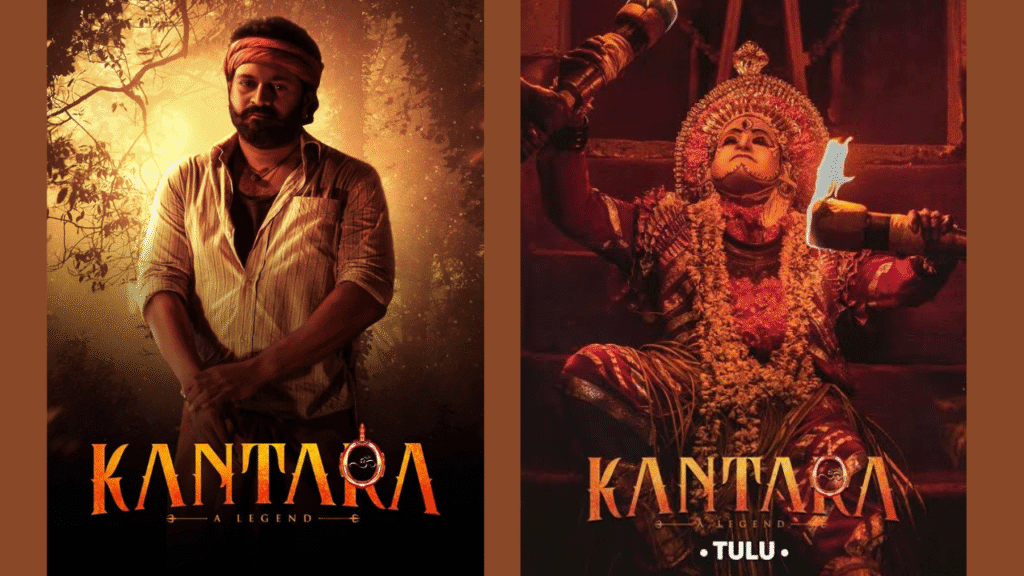
Cinema has the power to connect hearts, bridge regions, and celebrate traditions that often remain hidden from the mainstream. Kantara is one such film, a masterpiece that beautifully blends faith, folklore, and the spirit of rural India. Directed and acted by Rishab Shetty, and written by Manish Bhavan, Shanil Guru, and Anirudh Mahesh, Kantara has captured the imagination of audiences across India and the world. It not only entertains but also brings the rich and powerful Tulu culture into the national spotlight.
THE HEART OF “KANTARA”
Kantara revolves around the age-old traditions of the Tulu Nadu community, especially their deep faith in divine spirits known as Daivas. The story showcases the ritual of Bhuta Kola and the villagers’ belief in their protector deities, Panjurli and Guliga.
The film depicts the harmony between humans and nature and how greed can destroy that balance. It explores faith, humanity, and man’s fragile ego showing how divine forces reveal their presence when tested. Through its storytelling, Kantara reminds us of the importance of respecting nature and the unseen powers that protect it.

Kantara and Kantara Chapter , both have been a huge success for the director-actor Rishab Shetty. The Kannada film, which is set in pre-colonial Karnataka and depicts the conflict between the tribals of the Kantara forest and a tyrannical king, released in theatres on October 2 and had already earned more than Rs 427.5 crore.
Director Shetty comments on the success of the film saying, “Ultimately, our aim was for the audience to connect with the story and concept of the movie. The response that we got, we see it as ‘dakshina’, and it feels great. So, thank you to the audience.” He seems to have repeated the magic with Kantara: Chapter 1, which is set during the reign of the Kadamba dynasty in Banavasi in present-day Karnataka.
WHY “KANTARA” CAPTIVATED MILLIONS?
Kantara has gained so much popularity because it combines action, emotion, culture, and spirituality in one powerful story. The movie shows the deep connection between people and nature, and how traditions and beliefs shape their lives. Many viewers loved how it represents the rich culture of coastal Karnataka, especially through the traditional Bhoota Kola dance and rituals. The director and lead actor, Rishab Shetty, received huge praise for his performance and for bringing authenticity to every scene.

People also appreciated the strong storytelling, music, and cinematography that kept them engaged from start to finish. The background score and visual effects made the divine and action moments even more thrilling. Many said that Kantara felt different from regular commercial films because it connected deeply with emotions, faith, and the idea of justice. Viewers from all over India and even outside the country related to its message about respecting nature and traditions, which helped it become a massive hit.
THE WORLD OF TULU CULTURE
The film shows the Tulu culture a rich heritage from the Tulu-speaking people of Tulunadu (parts of Karnataka and Kerala), characterized by its unique traditions like Yakshagana (a night-long dance-drama), Bhoota Kola (spirit worship), Kambala (buffalo races), and the Aliyasantana system of matrilineal inheritance. The culture also includes worship of nature spirits like serpent gods (Naga Daiva), elaborate rituals, unique folk dances like Pili Vesha (tiger dance), and a distinctive cuisine.
Traditions and rituals:
- Bhoota Kola (Spirit Worship): A traditional ritual where priests enter a trance to become a local spirit (Bhoota) and resolve villagers’ issues.
- Nagaradhane (Snake Worship): Worship of serpent deities, believed to guard treasures, which takes place in sacred groves called Nagabana.
- Yakshagana: A traditional, night-long, open-air dance-drama performance that is a major part of Tulu culture.
- Kambala: An annual buffalo race held in water-filled paddy fields, a popular sport in the region.
- Pili Vesha: A unique folk dance where performers, dressed as tigers, perform during festivals like Dasara.
- Social structure:
- Aliyasantana: A matrilineal system of inheritance where property and lineage are passed down through the female line, from uncle to nephew.
- Arts and literature:
- Pāḍdanas: Oral folk songs that are part of the Tulu oral literature, often narrating the legends of the spirits and deities. They are crucial for preserving the history and cosmology of Tulu tribes.
- Tulu script: A script used to write the Tulu language. The Tulu Mahabharata is an example of early Tulu literature, dating back to the 15th century.

DIVINE ORIGIN OF THE DIETIES
“Kantara” is a Kannada word which means ‘mystical forest’ or a place with nature and spirituality. The film itself depicts a forest which is protected by a deity so that the villagers can reside in it peacefully but when someone tries to cut down the forest or harm the villagers in any way they face grave consequences.
The deities shown in the film are ‘Panjurli Daiva’ and ‘Guliga Daiva’, they both are companions. They are both known as ‘Kshetrapal Devtas’ or ‘Protectors of land’. Kestrapal Devtas are the guardian deities of a specific kshetra (land,territory or sacred space). They are the fierce protestors stationed at the boundaries of villages, temples, forests or regions. They ensure that no evil, impurity or adharma enters the land under their care. In many traditions, kshetrapal is worshipped as a form of Bhairav, a fierce manifestation of Bhagwan Shiv.
The story of ‘Panjurli Daiva’ begins with Mata Parvati. While walking through the forest, she came across a young boar whose mother had died. Filled with compassion she adopted the little creature and raised him as her own child. As the boar grew, his tusks began to itch and irritate him, causing him to destroy crops. Bhagwan Shiv got furious and sent the boar down to Earth, commanding him to protect the people and guide them. That is how the divine boar became known as ‘Panjurli Daiva’. ‘Panjurli’ means boar and Daiva means a demigod.

The tale of Guliga is even fierce. It is said that Mata Parvati brought sacred ash for Shiva, she found a stone in it. Bhagwan Shiva threw the stone away, when it landed in Vaikuntha, a terrifying demon was born, Guliga. He was appointed to serve Lord Vishnu, but due to his destructive nature Lord Vishnu cursed him to be reborn from a serpent named Nellalu. Guliga tore open the serpent’s womb and emerged with insatiable hunger. He devoured hens, fish, drank a lake dry yet nothing satisfied him. Finally, Lord Vishnu offered his finger which pacified him for a moment. Roaming the earth, he clashed with Panjurli over land. Their fierce battle was stopped only when Goddess Durga intervened. From that day, Guliga became Panjurli’s closest companion, and they have been worshipped together ever since.
The worship takes the form of Bhuta Kola, it is a combination of two words ‘Bhuta’ means ‘spirit’ and ‘Kola’ means ‘play’ or ‘enactment’. It is a century old ritual still alive in Tulu-Nadu. In this ritual, the divine spirits of Panjurli and Guliga descend into chosen performers from specific families. When these Daivas possess the performer, they listen to the villagers’ problems, deliver justice, and restore harmony. Just as it is shown in the film, the opening scene where Panjurli Daiva is answering the villagers.
Panjurli Daiva is seen as a benevolent protector, forgiving mistakes and guiding villagers with patience. Guliga Daiva, is fierce and rarely forgives the guilty. He appears only when his devotees are threatened. His spirit resides in a sacred stone and is invoked only in times of grave need.

There are many more Daivas like Koragajja Daiva, a benevolent protector and avatar of Shiva. He is particularly known to help people retrieve what they have lost and help solve their problems. Devotees offer him liquor, beetle leaves. Pilichamundi Daiva, ‘Pili’ means tiger and ‘Chamundi’ a form of goddess Durga. Pilichamundi is also shown in the film other than Guliga Daivas as protector. She is the sister of Guliga Daiva and is known as protector of cattle and land.
BHUTA KOLA: WHEN THE DIVINE WALKS AMONG US
Bhuta Kola takes place every year or every three years, it depends on village to village. It is a century old ritual still alive in Tulu-Nadu. In this ritual, the divine spirits of Panjurli and Guliga descend into chosen performers from specific families. When these Daivas possess the performer, they listen to the villagers’ problems, deliver justice, and restore harmony.
Bhuta Kola is performed by the elderly person in the family and is done by a man only. It is passed down to generation. The offerings made by the family for the Kola festival are known as Tambila. The family arranging the Kola has to feed the whole village and do all the arrangements for the Kola festival.
Spirits of ‘Panjurli Daiva’ and ‘Guliga Daiva’ are worshipped. The performer wears ‘Vesha’, applies face paint, and drums are played to summon the Daivas and worship them. A special dance is done by the former. Kola starts from 7pm and goes till 7am in the morning. Offerings of poha, jaggery and chicken are made to Daivas. Chicken’s blood should be dropped as a worship.
Every family has a stone known as ‘Daiva’ in their home, some people allocate a whole room for Daivas, and some place them in a corner of the room. And in the film the Daiva shown is for the whole village so they are placed near the boundary of the forest.

FAITH BEYOND FICTION
At a shrine/katte of Koragajja in Mangaluru, two men (identified as Raheem and Taufiq) and a third associate (Nawaz) are accused of desecrating the temple offering box (“hundi”) and the temple premises. They reportedly dropped a condom into the hundi and urinated inside the temple complex. The duo later went to the temple priest and confessed their acts. They then surrendered themselves to the police via the temple authorities.
The reason they gave for surrender was fear of divine retaliation: their third associate Nawaz reportedly fell ill (vomiting blood, dysentery), and then died, allegedly after banging his head, proclaiming that “Koragajja is angry”. Raheem and Taufiq reportedly suffered symptoms too and then decided to seek forgiveness. The police registered a case under section 153A of the Indian Penal Code (which covers promoting enmity between groups) among other charges.
Kantara is more than a film; it’s a song for India’s wild regional heart, a bold hymn of cultural pride and a deep dive into spiritual mystery. It gives the Tulu people a voice that resounds across the world, celebrating their ancient rituals without apology. By blending myth with reality, it restores faith in divine justice and the sacred bond between humanity and nature.
Kantara: Chapter 1 doesn’t just serve as a prequel it resurrects the soul of Tulu Nadu, urging us to honor the wild divine in an age of forgetfulness. As Shetty’s saga grows and whispers of Chapter 2 begin to stir, one truth echoes through the forest: in the heart of the ancient land, true power never fades. Watch it, feel the Daiva awaken, and remember myths aren’t merely told; they are lived.
Aishwarya Rajput is a media researcher and writer exploring the intersections of cinema, culture, and community narratives through an academic and creative lens.