Garima Kaushiki | 21st November 2025
Every 14 November, classrooms across India burst into colour. Hand-cut decorations flutter on soft-board walls, teachers rehearse dances long after the bell rings, loudspeakers hum with film songs, and children shuffle between stage performances and photo booths, their faces bright with the promise of treats. It is a ritual repeated every year — chocolates passed around, selfies captured, reels uploaded, and the familiar greeting, “Happy Children’s Day.”
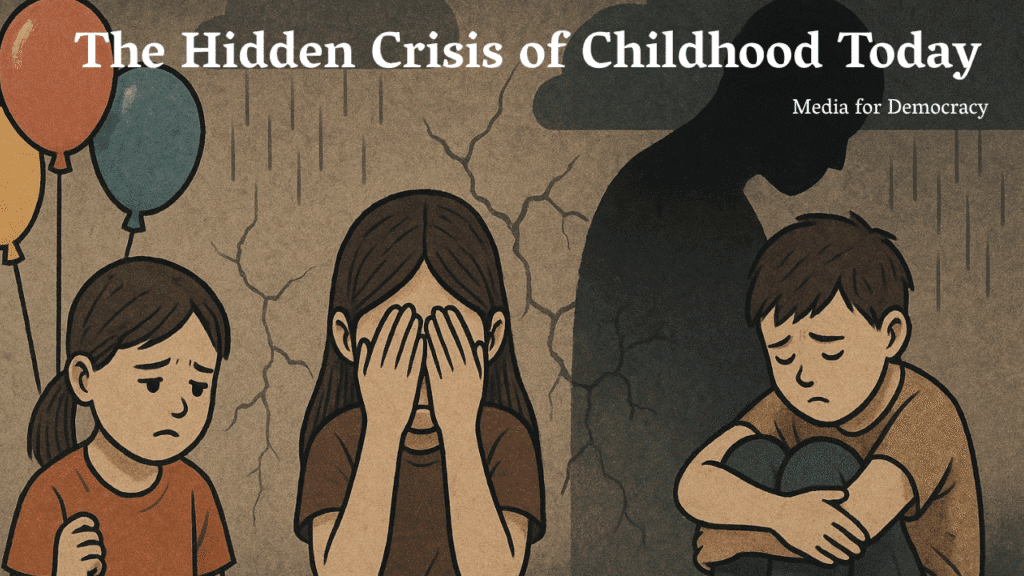
Yet behind the balloons and painted smiles lies a quieter truth.
Many children today are not happy — not even on the day meant for them.
A Celebration Filled with Silence
In one Delhi classroom, 13-year-old Nidhi sat at the edge of the festivities, eyes fixed on her phone while her classmates laughed through a game of musical chairs. To most, she seemed like any other teenager idly scrolling. What no one saw was her growing withdrawal — weeks of skipped conversations, solitary lunches, and a silent dependence on her screen to fill an emotional void.
“Everyone assumed she was shy,” her teacher said later. “But sometimes a quiet child isn’t shy — she’s struggling.”
On a day meant to celebrate her, Nidhi went unseen.
She is not an exception.
She is a reflection.
Always Online, Rarely Heard
Children today inhabit two parallel worlds. The real one demands performance; the digital one insists on perfection. Trapped between the two, many are growing up exhausted long before they have the language to express it.
In conversations with students across Delhi and Patna, a pattern emerges. A 15-year-old girl admits she pretends to be confident online because “everyone else looks perfect.” A 12-year-old boy says he is afraid to tell his parents he feels stressed. An 11-year-old says people ask what’s wrong if she doesn’t smile for photos. A 14-year-old sums it up with aching simplicity: “School is tiring. Home is tiring. Phone is tiring.”
At an age meant for discovery, many are instead disconnecting from their own emotions.
The Pressure We Refuse to See
Behind every cheerful photo post lies a quiet landscape of distress. India has nearly 40 million children who need psychological support — yet fewer than one percent of schools employ a full-time counsellor. In clinics and staff rooms across major cities, the symptoms are becoming all too familiar: anxiety, irritability, attention issues, withdrawal.
“Children can identify emojis better than their own emotions,” a Delhi psychologist said with a laugh — one that faded quickly .
Teachers report perfection anxiety creeping into even the earliest grades. Digital comparison has replaced curiosity with self-doubt. UNICEF’s 2024 mental-health mapping lays bare the crisis: children are struggling at unprecedented levels, while professional support remains painfully scarce.
“By the time they reach me,” said a Bengaluru counsellor, “silence has already taken root”.
Anmol’s Story: A Mirror to Modern Childhood
Fifteen-year-old Anmol once lived for the football field. Then, almost overnight, he stopped going. His parents chalked it up to teenage moodiness — until a school wellness session revealed the truth. Anmol had been bullied online about his weight. The comments pierced more deeply than anyone realised.
“I didn’t want to be a problem,” he whispered to the school counsellor.
His mother wept quietly when she learned the truth. “We live under one roof,” she said, “yet my son felt completely alone.”
Childhood today rarely breaks dramatically. It breaks silently.
Are We Upholding Nehru’s Promise?
Pandit Jawaharlal Nehru imagined childhood as the purest foundation of the nation — a time to nurture wonder, empathy, and emotional security. But the world children now inherit offers something else: expectations without guidance, independence without safety, connectivity without connection, achievement without self-worth.
A sociologist expressed it poignantly:
“We protect children from broken bones, but not from broken emotions.”
Why Children Don’t Speak
When children are hurting, they retreat into silence. Fear of judgment, fear of being scolded, shame, or simply the belief that “adults won’t understand” keeps their emotions tucked away. Busy parents miss subtle signs. Schools celebrate marks more loudly than mental well-being. Emotional vocabulary remains untaught — leaving children unable to name what they feel.
“Children smile for photos,” a school counsellor said, “not because they’re happy, but because they don’t know what else to do.”
What Children’s Day Should Mean Today
If Children’s Day is truly a celebration of childhood, then it must go beyond performances and sweets. It must transform into a collective pause — a moment for India to ask whether its children feel safe, heard, and understood.
Schools need more counsellors and fewer silences. Homes need presence, not perfection. Parents must listen as much as they instruct, and teachers must learn to spot distress as readily as talent. Children must be taught emotional literacy — the words to say, “I’m scared,” “I’m anxious,” or “I need help.”
The greatest gift we can offer is not a chocolate bar or a framed photograph.
It is the quiet assurance that their feelings matter.
Childhood Is Fleeting. Its Scars Are Not.
As the music fades and the decorations come down, as photos settle into forgotten galleries, the inner world of a child remains — filled with fears, doubts, and unspoken longing. These emotions do not disappear when the festival ends.
This Children’s Day, India faces a choice: continue masking a crisis behind cheerful celebration, or confront it with honesty, empathy, and action.
Let the day be more than a festival.
Let it be a mirror.
A national commitment.
A promise to protect the child behind the smile.
Because beyond the balloons and painted joy lies something fragile and irreplaceable — a childhood waiting to be heard, healed, and truly celebrated.
Garima Kaushiki is a media researcher and writer with a focus on education, child rights, and mental health. She combines data-driven insights with human stories to highlight systemic gaps and advocate for meaningful change.