
Prajakta Kadam and Chatura Juwatkar | 29th November 2025
Every evening, as most families get into dinner routines, another movement begins on a quieter scale throughout Mumbai. Six o’clock strikes, and something shifts, kitchen lights go off in some homes, saree pallus are tightened, children are given last-minute instructions, and women step out, mostly with notebooks tucked under their arms.
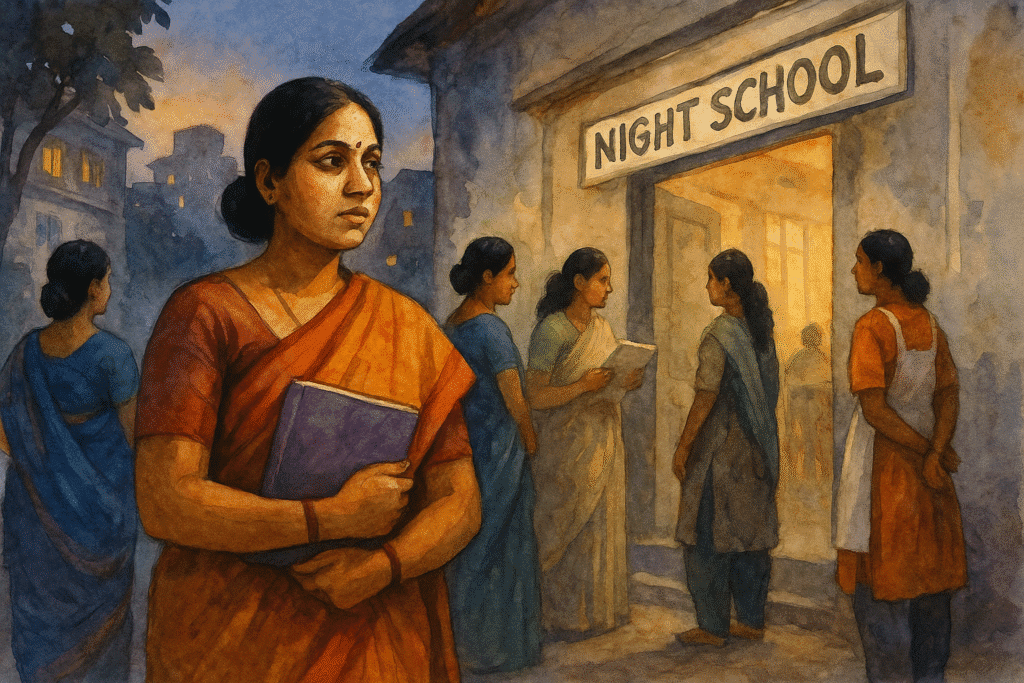
The scene repeats itself in every lane near local municipal schools, NGOs, and community learning centres: a group of women. Some in uniforms, some in work aprons and some still smelling of masalas from the day’s cooking, congregating outside classrooms for night school.
Over weeks of visiting these centres, watching classes, and speaking to students and teachers, one thing becomes clear: after 6 PM, a silent gender revolution unfolds — one that seldom hits headlines, yet reshapes womanhood in India’s cities.
After 6 PM, time finally becomes theirs.
The rhythm for almost every woman we observed was similar: mornings reserved for cooking, cleaning, and seeing family members off, afternoons spent managing homes or working, evenings again tied to preparing dinner.
Education rarely finds space in that schedule.
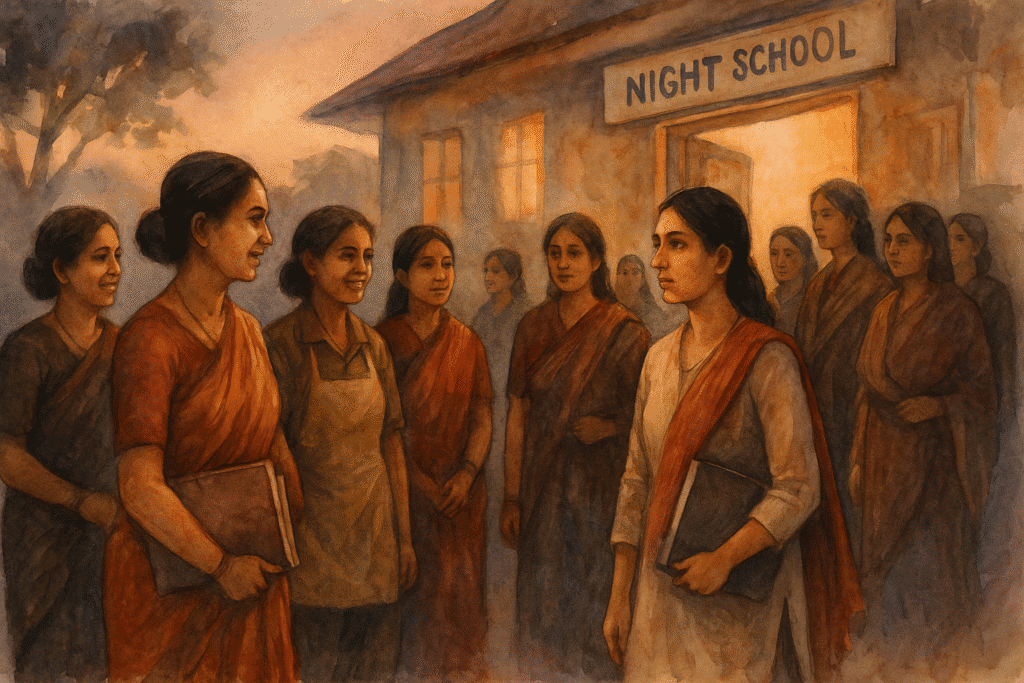
But after 6 PM, that tiny sliver of permission between responsibility and exhaustion, learning can happen. Many women said that night school is their only possible alternative. “Daytime is not ours,” one student put it candidly. “Evening is when we can think about ourselves.”
It is a powerful time, and rather instructive, to watch them enter classrooms after a full day of unpaid, often invisible work. The hours after 6 PM are no longer only “family hours.” They are slowly becoming self-hours.
The return to learning is also the return to self.
We noticed time and time again that when women re-enter education even after decades. They rediscover parts of themselves lost to routine.
Some had passed Class 8 recently, others had just completed SSC; a few were studying for HSC or B.Com in night colleges. Their ages ranged from early 20s to late 40s, yet their motivations were strikingly similar. Confidence, independence, employability, and the desire to prove something to themselves.
In one center, we witnessed a mother and her teenage daughter solving the same commerce homework. In another, a woman proudly flashed her Tally certificate, something she finished during a “repeat year” she had once feared might be only a setback. These are not just academic milestones but also deeply emotional ones. Night school doesn’t just give women literacy; it gives them life chances.
A shift from “only caregiver” to “learner, worker, decision-maker”. Womanhood in an urban setting has long been attached to roles such as wife, mother, and caregiver. In night classrooms, however, we saw those roles expand.
Women spoke of wanting to understand bank forms, use digital apps, or apply for government schemes themselves not depend on anyone. Others joined skill-based evening batches, hoping to earn or start small home-run enterprises.
As one teacher noted, “Once they start studying, their families start listening to them differently.”
Education changes posture, not just literally but socially. With a woman earning or studying, she gains new space in household decisions: when to work, how to budget money, whether to continue education, how to support children. Night school thus becomes a small but significant beginning to negotiating womanhood on her own terms.
Claiming the city at night – safely, collectively, confidently
Stepping out after sunset has traditionally been discouraged for women, especially in working-class neighbourhoods. But night schools offer something rare: a legitimate, safe, socially acceptable reason for women to be outside after dark.
Outside several centres, we saw clusters of women arriving in groups, some walking, some taking shared autos, some rushing from work.
Teachers tell us this collective movement itself brings a sense of safety. “I’m not afraid when I walk with ten other women,” one student laughed.
These “study groups” often spill over into the commute-revising lessons at bus stops, discussing exams in trains, sharing notes while waiting for rickshaws. Their presence in these public spaces changes what is considered “normal” for women after dark. Every night that they venture out, they rewrite in silence the unspoken rules of the city.
Education becomes economic power, even when incomes are small.
Across many centres, the teachers mentioned that evening skill courses, particularly those related to computers, accounting, basic finance, or office assistant training have facilitated employment or micro-businesses for women.
Some are now supporting family shops with bookkeeping. Others support neighbors filling in online forms or digital applications, while others earn an extra part-time income through home services.
Amounts may not always be large, but the impact is.
“When I started earning even a little,” said a woman, “my words carried more weight at home.” The night schools give women not only employment but economic dignity.
Yet the struggle is far from simple.
Even with their determination, women do face steep obstacles. Household chores don’t stop because of exams. Younger siblings must be looked after; older parents must be taken care of.
Safe transport is not always guaranteed. Some family members or partners are not supportive.
Domestic labour fatigue makes studying difficult.
One teacher informed us that in almost every batch, there are dropouts because of marriage, shifting, childbirth, or familial pressure.
Night schools function within a deeply unequal structure, yet they keep drawing women back into education, even if it is in small numbers.
Little victories that shape the future
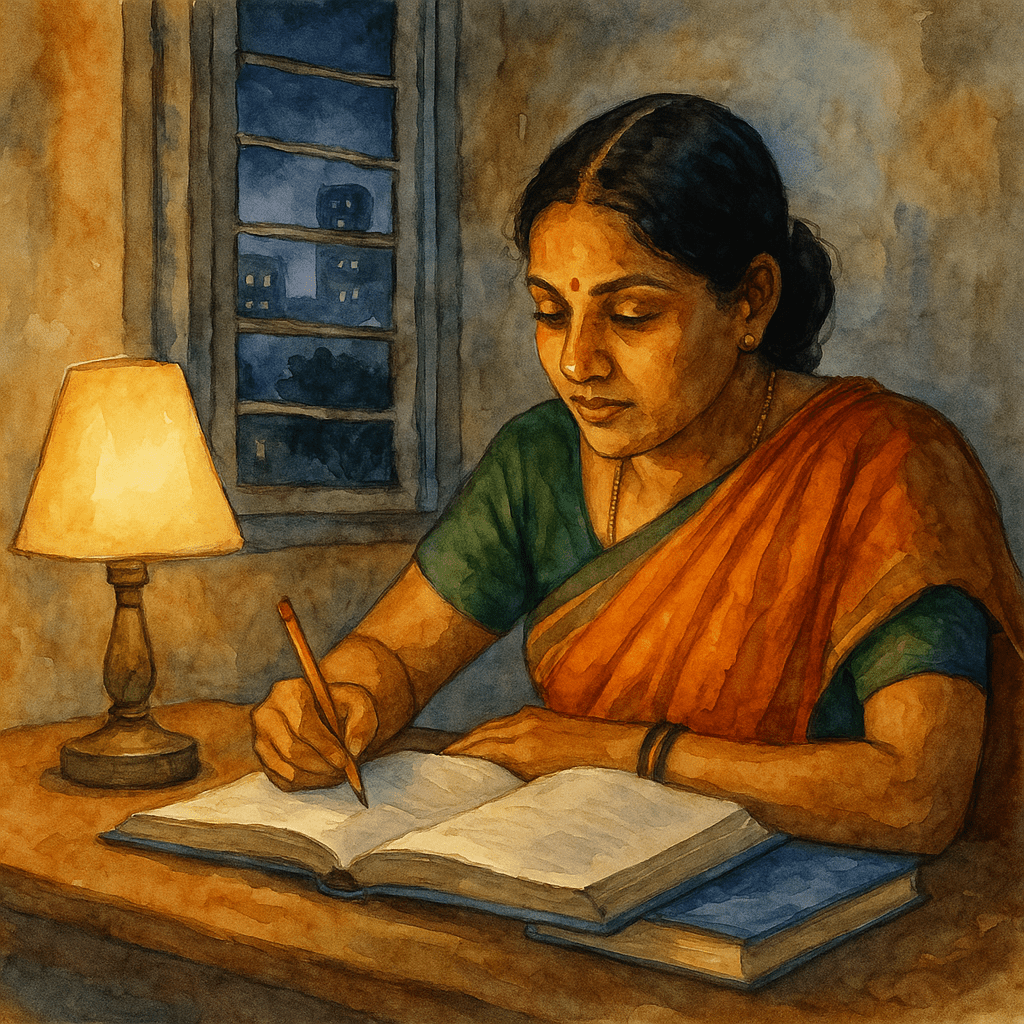
The revolution happening inside night classrooms isn’t loud or dramatic. It shows up in the most everyday scenes. A woman confidently signing her own name for the first time. A mother who studies while her teenage son quizzes her. A worker who attends classes after a twelve-hour shift. A wife who negotiates an hour of quiet time to revise. A grandmother learning English so that she can help her granddaughter. These aren’t just stories, they’re signs of how gender norms bend, slowly and subtly, but powerfully.
A new definition of womanhood is taking shape
In the women we met and observed, a new urban womanhood emerges, one that amalgamates tradition with aspiration. She cooks dinner, but she also carries textbooks. She cares for the family, but she invests in herself, too. She is tired, but shows up. She is afraid, yet every night she ventures out.
She negotiates, resists, persists. Night schools do not only educate women, but they uplift them. They give them a vocabulary for independence, courage for mobility, and proof that growth is possible at any age. The revolution is quiet but unstoppable There are no banners in these classrooms. No slogans. No speeches. Just a quiet, determined group of women who, after completing everything expected of them by the rest of the world, choose to do something for themselves. This is the silent gender revolution after 6 PM, one evening class, one homework sheet, and one confident step at a time.
Chatura Juwatkar and Prajakta Kadam are media educators who believe in amplifying stories of resilience, learning, and unsung changemakers through their work.